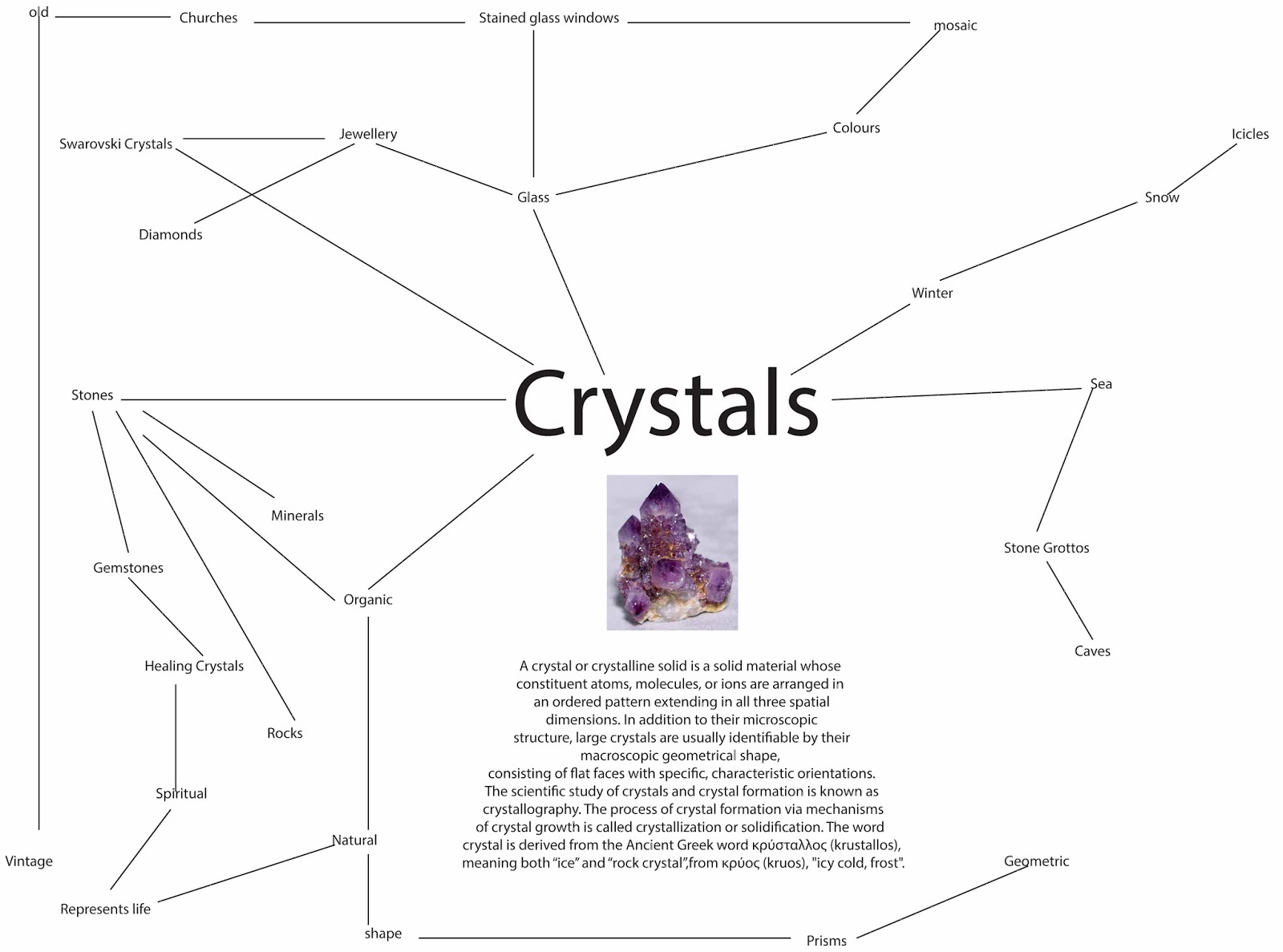
Crystal or crystalline solid is a solid material whose constituent atoms, molecules, or ions are arranged in an ordered pattern extending in all three spatial dimensions. In addition to their microscopic structure, large crystals are usually identifiable by their macroscopic geometrical shape, consisting of flat faces with specific, characteristic orientations.[citation needed]
The scientific study of crystals and crystal formation is known as crystallography. The process of crystal formation via mechanisms of crystal growth is called crystallization or solidification. The word crystal is derived from the Ancient Greek word κρύσταλλος (krustallos), meaning both “ice” and “rock crystal”,from κρύος (kruos), "icy cold, frost".
Examples of large crystals include snowflakes, diamonds, and table salt. Most inorganic solids are not crystals but polycrystals, i.e. many microscopic crystals fused together into a single solid. Examples of polycrystals include most metals, rocks, ceramics, and ice. A third category of solids is amorphous solids, where the atoms have no periodic structure whatsoever. Examples of amorphous solids include glass, wax, and many plastics.
Crystal structure (microscopic) Halite (table salt, NaCl): Microscopic and macroscopic


Main article: Crystal structure
The scientific definition of a "crystal" is based on the microscopic arrangement of atoms inside it, called the crystal structure. A crystal is a solid where the atoms form a periodic arrangement. (Quasicrystals are an exception, seebelow.)
Not all solids are crystals. For example, when liquid water starts freezing, the phase change begins with small ice crystals that grow until they fuse, forming a polycrystalline structure. In the final block of ice, each of the small crystals (called "crystallites" or "grains") is a true crystal with a periodic arrangement of atoms, but the whole polycrystal does not have a periodic arrangement of atoms, because the periodic pattern is broken at the grain boundaries. Most macroscopic inorganic solids are polycrystalline, including almost all metals, ceramics, ice, rocks, etc. Solids that are neither crystalline nor polycrystalline, such as glass, are called amorphous solids, also calledglassy, vitreous, or noncrystalline. These have no periodic order, even microscopically. There are distinct differences between crystalline solids and amorphous solids: most notably, the process of forming a glass does not release the latent heat of fusion, but forming a crystal does.
A crystal structure (an arrangement of atoms in a crystal) is characterized by its unit cell, a small imaginary box containing one or more atoms in a specific spatial arrangement. The unit cells are stacked in three-dimensional space to form the crystal.
The symmetry of a crystal is constrained by the requirement that the unit cells stack perfectly with no gaps. There are 219 possible crystal symmetries, calledcrystallographic space groups. These are grouped into 7 crystal systems, such as cubic crystal system (where the crystals may form cubes or rectangular boxes, such ashalite shown at right) or hexagonal crystal system (where the crystals may form hexagons, such as ordinary water ice).
Crystal faces and shapes 

Crystals are commonly recognized by their shape, consisting of flat faces with sharp angles. These shape characteristics are not necessary for a crystal—a crystal is scientifically defined by its microscopic atomic arrangement, not its macroscopic shape—but the characteristic macroscopic shape is often present and easy to see.
Euhedral crystals are those with obvious, well-formed flat faces. Anhedral crystals do not, usually because the crystal is one grain in a polycrystalline solid.
The flat faces (also called facets) of a euhedral crystal are oriented in a specific way relative to the underlyingatomic arrangement of the crystal: They are planes of relatively low Miller index.[4] This occurs because some surface orientations are more stable than others (lower surface energy). As a crystal grows, new atoms attach easily to the rougher and less stable parts of the surface, but less easily to the flat, stable surfaces. Therefore, the flat surfaces tend to grow larger and smoother, until the whole crystal surface consists of these plane surfaces. (See diagram on right.)
One of the oldest techniques in the science of crystallography consists of measuring the three-dimensional orientations of the faces of a crystal, and using them to infer the underlying crystal symmetry.
A crystal's habit is its visible external shape. This is determined by the crystal structure (which restricts the possible facet orientations), the specific crystal chemistry and bonding (which may favor some facet types over others), and the conditions under which the crystal formed.
Occurrence in nature 

Rocks[edit]
By volume and weight, the largest concentrations of crystals in the earth are part of the Earth's solid bedrock.
Some crystals have formed by magmatic and metamorphic processes, giving origin to large masses of crystalline rock. The vast majority of igneous rocks are formed from molten magma and the degree of crystallization depends primarily on the conditions under which they solidified. Such rocks as granite, which have cooled very slowly and under great pressures, have completely crystallized; but many kinds of lava were poured out at the surface and cooled very rapidly, and in this latter group a small amount of amorphous or glassy matter is common. Other crystalline rocks, the metamorphic rocks such as marbles, mica-schists andquartzites, are recrystallized. This means that they were at first fragmental rocks like limestone, shale and sandstone and have never been in a molten condition nor entirely in solution, but the high temperature and pressure conditions of metamorphism have acted on them by erasing their original structures and inducing recrystallization in the solid state.[5]
Other rock crystals have formed out of precipitation from fluids, commonly water, to form druses or quartz veins. The evaporitessuch as halite, gypsum and some limestones have been deposited from aqueous solution, mostly owing to evaporation in arid climates.
Ice[edit]
Water-based ice in the form of snow, sea ice and glaciers is a very common manifestation of crystalline or polycrystalline matter on Earth. A single snowflake is typically a single crystal, while an ice cube is a polycrystal.
Organigenic crystals[edit]
Many living organisms are able to produce crystals, for example calcite and aragonite in the case of most molluscs or hydroxylapatite in the case of vertebrates.
Polymorphism and allotropy[edit]
Main articles: Polymorphism (materials science) and Allotropy
The same group of atoms can often solidify in many different ways. Polymorphism is the ability of a solid to exist in more than one crystal form. For example, water ice is ordinarily found in the hexagonal form Ice Ih, but can also exist as the cubic Ice Ic, the rhombohedral ice II, and many other forms. The different polymorphs are usually called different phases.
In addition, the same atoms may be able to form noncrystalline phases. For example, water can also form amorphous ice, while SiO2 can form both fused silica (an amorphous glass) and quartz (a crystal). Likewise, if a substance can form crystals, it can also form polycrystals.
For pure chemical elements, polymorphism is known as allotropy. For example, diamond and graphite are two crystalline forms of carbon, while amorphous carbon is a noncrystalline form. Polymorphs, despite having the same atoms, may have wildly different properties. For example, diamond is among the hardest substances known, while graphite is so soft that it is used as a lubricant.
Polyamorphism is a similar phenomenon where the same atoms can exist in more than one amorphous solid form.
Crystallization[edit]

Main articles: Crystallization and Crystal growth
Crystallization is the process of forming a crystalline structure from a fluid or from materials dissolved in a fluid. (More rarely, crystals may bedeposited directly from gas; see thin-film deposition and epitaxy.)
Crystallization is a complex and extensively-studied field, because depending on the conditions, a single fluid can solidify into many different possible forms. It can form a single crystal, perhaps with various possible phases, stoichiometries, impurities, defects, and habits. Or, it can form a polycrystal, with various possibilities for the size, arrangement, orientation, and phase of its grains. The final form of the solid is determined by the conditions under which the fluid is being solidified, such as the chemistry of the fluid, the ambient pressure, thetemperature, and the speed with which all these parameters are changing.
Specific industrial techniques to produce large single crystals (called boules) include the Czochralski process and the Bridgman technique. Other less exotic methods of crystallization may be used, depending on the physical properties of the substance, including hydrothermal synthesis, sublimation, or simply solvent-based crystallization.
Large single crystals can be created by geological processes. For example, selenite crystals in excess of 10 meters are found in the Cave of the Crystals in Naica, Mexico.[6] For more details on geological crystal formation, see above.
Crystals can also be formed by biological processes, see above. Conversely, some organisms have special techniques to prevent crystallization from occurring, such asantifreeze proteins.
Defects, impurities, and twinning[edit]


Main articles: Crystallographic defect, Impurity and Crystal twinning
An ideal crystal has every atom in a perfect, exactly repeating pattern. However, in reality, most crystalline materials have a variety of crystallographic defects, places where the crystal's pattern is interrupted. The types and structures of these defects may have a profound effect on the properties of the materials.
A few examples of crystallographic defects include vacancy defects (an empty space where an atom should fit), interstitial defects (an extra atom squeezed in where it does not fit), and dislocations (see figure at right). Dislocations are especially important in materials science, because they help determine the mechanical strength of materials.
Another common type of crystallographic defect is an impurity, meaning that the "wrong" type of atom is present in a crystal. For example, a perfect crystal of diamond would only contain carbon atoms, but a real crystal might perhaps contain a fewboron atoms as well. These boron impurities change the diamond's color to slightly blue. Likewise, the only difference between ruby and sapphire is the type of impurities present in a corundum crystal.
In semiconductors, a special type of impurity, called a dopant, drastically changes the crystal's electrical properties. Semiconductor devices, such astransistors, are made possible largely by putting different semiconductor dopants into different places, in specific patterns.
Twinning is a phenomenon somewhere between a crystallographic defect and a grain boundary. Like a grain boundary, a twin boundary has different crystal orientations on its two sides. But unlike a grain boundary, the orientations are not random, but related in a specific, mirror-image way.
Chemical bonds[edit]
Crystalline structures occur in all classes of materials, with all types of chemical bonds. Almost all metal exists in a polycrystalline state; amorphous or single-crystal metals must be produced synthetically, often with great difficulty. Ionically bonded crystals can form upon solidification of salts, either from a molten fluid or upon crystallization from a solution. Covalently bonded crystals are also very common, notable examples being diamond, silica, and graphite. Polymer materials generally will form crystalline regions, but the lengths of the molecules usually prevent complete crystallization. Weak van der Waals forces can also play a role in a crystal structure; for example, this type of bonding loosely holds together the hexagonal-patterned sheets in graphite.
Leading Crystal Brand
Swarovski
The brand

00:00
In 1895, Daniel Swarovski, a Bohemian inventor and visionary, moved to the village of Wattens, Tyrol in Austria, with his newly-invented machine for cutting and polishing crystal jewelry stones.
From this beginning that revolutionised the fashion world, Swarovski has grown to be the world’s leading producer of precision-cut crystal for fashion, jewelry and more recently lighting, architecture and interiors.
Today, the company, still family-owned and run by 5th generation family members, has a global reach with some 25,000 employees, a presence in over 120 countries and a turnover in 2012 of 2.38 billion Euros.
Swarovski comprises two major businesses, one producing and selling loose elements to the industry and the other creating design-driven finished products. Swarovski crystals have become an essential ingredient of international design. Since 1965 the company has also catered to the fine jewelry industry with precision-cut genuine gemstones and created stones.
Showing the creativity that lies at the heart of the company, Swarovski’s own brand lines of accessories, jewelry and home décor items are sold through more than 2,350 retail outlets worldwide. The Swarovski Crystal Society has close to 300,000 members across the world, keen collectors of the celebrated crystal figurines. And in Wattens, Swarovski Kristallwelten, the multi-media crystal museum, was opened in 1995 as a celebration of Swarovski’s universe of innovation and inspiration.
http://www.swarovski-elements.com/home/index.en.html?stay
SWAROVSKI ELEMENTS

SWAROVSKI ELEMENTS is the premium brand for the finest crystals
manufactured by Swarovski. The designers’ choice since the founding
of the company in 1895, SWAROVSKI ELEMENTS, provides creative
talents from the world of fashion, jewelry, accessories, interior design
and lighting with the latest on-trend innovations.
Available in myriad colors, effects, shapes and sizes,
SWAROVSKI ELEMENTS offer designers a fabulous palette of inspiration.
Born out of passion for detail and high-precision cutting, they impart
refined glamour to everything they embellish.
These precious ingredients can be recognized through the
“MADE WITH SWAROVSKI ELEMENTS” label, which serves
as a certificate of authenticity. It marks products that are
made with genuine SWAROVSKI ELEMENTS.
manufactured by Swarovski. The designers’ choice since the founding
of the company in 1895, SWAROVSKI ELEMENTS, provides creative
talents from the world of fashion, jewelry, accessories, interior design
and lighting with the latest on-trend innovations.
Available in myriad colors, effects, shapes and sizes,
SWAROVSKI ELEMENTS offer designers a fabulous palette of inspiration.
Born out of passion for detail and high-precision cutting, they impart
refined glamour to everything they embellish.
These precious ingredients can be recognized through the
“MADE WITH SWAROVSKI ELEMENTS” label, which serves
as a certificate of authenticity. It marks products that are
made with genuine SWAROVSKI ELEMENTS.
Designers’ choice since 1895
SWAROVSKI ELEMENTS celebrates crystal's creative versatility with spectacular one-off events
As the appeal of crystal broadens, designers explore new expressions of creativity in all these spheres and more. To celebrate the unlimited uses to which crystal is put, SWAROVSKI ELEMENTS has launched exciting, one-off initiatives to the delight of audiences worldwide. Among these are the ”22 Ways to Say Black" exhibition, the “Wedding” project and “SWAROVSKI ELEMENTS at Work”, bringing together some of the most exciting personalities in design to display unique creations, all glittering with crystal.
Experience our Initiatives
As the appeal of crystal broadens, designers explore new expressions of creativity in all these spheres and more. To celebrate the unlimited uses to which crystal is put, SWAROVSKI ELEMENTS has launched exciting, one-off initiatives to the delight of audiences worldwide. Among these are the ”22 Ways to Say Black" exhibition, the “Wedding” project and “SWAROVSKI ELEMENTS at Work”, bringing together some of the most exciting personalities in design to display unique creations, all glittering with crystal.
Experience our Initiatives

Certificate of authenticity
To emphasize the premium nature of the SWAROVSKI ELEMENTS brand, selected designers and brands are permitted to use the distinctive, trapezoid-shaped “MADE WITH SWAROVSKI ELEMENTS” label. It serves as a certificate of authenticity, denoting products that are made with genuine SWAROVSKI ELEMENTS. Swarovski also offers branding partners additional first-class services, including trend consultancy and technical expertise.
Gorgeous, refined and functional, SWAROVSKI ELEMENTS are the preferred choice for major designers around the world. In their hands, crystal comes alive to give works of startling beauty and originality.
Gorgeous, refined and functional, SWAROVSKI ELEMENTS are the preferred choice for major designers around the world. In their hands, crystal comes alive to give works of startling beauty and originality.
Why Swarovski
Swarovski is the premium brand for the finest crystal elements. For more than 100 years, the company has been recognized for its pioneering spirit, its collaborations with designers, and its responsible behavior.
In its continuous effort to strive for excellence and the highest standards of customer service, Swarovski has created a comprehensive product and service offering that delivers distinctive values to its customers.
EXCELLENCE, THROUGH INNOVATION AND ORIGIN


PREMIUM, BY SERVICE AND DESIGN


COMPLIANCE, WITH INTEGRITY


OEKO-TEX
SWAROVSKI ELEMENTS: 2013 BRAND CAMPAIGN
I love the perfection of crystals and roses – one created by man and the other created by nature, but both the ultimate in luxury. (Nick Knight, photographer)
Crackling with high-voltage glamour, Swarovski’s powerful new 2013 corporate advertising campaign stars supermodel Candice Swanepoel as super-glam action heroine shimmering in a blaze of SWAROVSKI ELEMENTS, seen through the lens of award-winning British photographer Nick Knight. Created by Ronnie Cooke Newhouse, of House and Holme, this campaign features modern woman at her very zenith—fit and strong, coolly confident and in control, wielding crystallized fantasy sports accessories, including a motorbike helmet, skiing goggles, and dumbbells, each blazing with the reflected light of thousands of SWAROVSKI ELEMENTS.
The concept behind the campaign was designed to reflect the brand’s attributes and the versatility of SWAROVSKI ELEMENTS as an innovative ingredient across the creative industries from jewelry, fashion, and accessories, to lighting, architecture, and interiors, and art, stage, and screen. The campaign will break in March books worldwide – first release date February 2013 onwards as part of a global media campaign.
The concept behind the campaign was designed to reflect the brand’s attributes and the versatility of SWAROVSKI ELEMENTS as an innovative ingredient across the creative industries from jewelry, fashion, and accessories, to lighting, architecture, and interiors, and art, stage, and screen. The campaign will break in March books worldwide – first release date February 2013 onwards as part of a global media campaign.
CORPORATE RESPONSIBILITY
Our commitment to Corporate Responsibility has been embedded in the way we do business since our company was created by Daniel Swarovski in 1895. We maintain this tradition today in how we strive to add sparkle to the everyday lives of our employees, customers and suppliers and the broader community on a global scale, while protecting the natural environment and seeking to leave a rich legacy for future generations.
To learn more about our Corporate Responsibility at Swarovski visit brand.swarovski.com.
To learn more about our Corporate Responsibility at Swarovski visit brand.swarovski.com.

The Swarovski Foundation
Swarovski's visionary founder Daniel Swarovski, who established the business in Wattens, Austria, in 1895, demonstrated a strong humanitarian instinct, ensuring that his business cared for its people and the local community. Since then, five generations of the Swarovski family have reinforced Daniel Swarovski's commitment to charitable giving, both within the community and in the wider realms of the environment, health, arts and culture. The Swarovski Foundation has been created to build on this heritage.
To learn more about the Swarovski Foundation visitwww.swarovskifoundation.org/.
To learn more about the Swarovski Foundation visitwww.swarovskifoundation.org/.

The Swarovski Waterschool Program
Water has always been a key element in the company’s production but also in its culture and philosophy, which from Swarovski’s earliest days demanded a respect for human and environmental values.
The objectives of the Waterschool program are to create awareness amongst the participants of the fact that water is essential to our survival, to teach the principles of sustainable water management, and to provide clean drinking water and water sanitation in schools and surrounding communities where the Waterschool program is active.
In the past thirteen years, the program has reached approximately 196,188 children in 2,654 schools worldwide. Around 1,472 teachers have been trained and 264,996 community members have been involved in various water projects.
To learn more about the Swarovski Waterschool program visitwww.swarovskiwaterschool.com.
The objectives of the Waterschool program are to create awareness amongst the participants of the fact that water is essential to our survival, to teach the principles of sustainable water management, and to provide clean drinking water and water sanitation in schools and surrounding communities where the Waterschool program is active.
In the past thirteen years, the program has reached approximately 196,188 children in 2,654 schools worldwide. Around 1,472 teachers have been trained and 264,996 community members have been involved in various water projects.
To learn more about the Swarovski Waterschool program visitwww.swarovskiwaterschool.com.